
Pope County Bench Warrants Explained
A bench warrant comes from the bench, not from a new arrest. It is a judge's order issued out of an existing case, typically after a missed court date, a violated release condition, or some other requirement the court set that went unmet. Minnesota has no separate bench warrant court. Pope County runs one trial court, so a warrant tied to a city ordinance matter, a traffic citation, or a felony case all traces to the same bench in Glenwood. The phrase describes a process rather than a building. That is why the useful questions center on the event itself. What was missed, when did it happen, and what does the court now require of the person who missed it? Those answers, not the label, tell you what to do next in Pope County.
Pope County FTA Warrants and Sign-and-Release
Failure to appear can lead down three different paths in Minnesota. The court might issue a summons, an ordinary arrest warrant, or a sign-and-release warrant under section 629.415. Sign-and-release works very differently from the others. It carries no bail and no conditions, and it does not authorize an arrest at all. The officer hands over written notice of a new appearance and lets the person go. An ordinary warrant does the opposite, allowing custody and possibly setting bail. Eligibility turns on the specifics of the case, and the court makes that call. Before you plan around a Pope County warrant, ask which type was issued.
How Pope County Bench Warrants Are Issued
Every bench warrant in Pope County traces back to a court event, usually a failure to appear. The prosecutor applies for it, and the written application sets out the facts the judge will weigh. That document identifies the file number, the missed date, the citation or summons, the offense, and the prosecutor behind the request. It also carries a probable-cause statement. The warrant itself is addressed to the sheriff or another authorized person, with instructions to bring the defendant before a judge promptly. The judge then decides whether to sign. Rule 3 supplies the general framework for warrants and summonses, and Rule 6 governs release conditions and what happens after a violation.
Pope County FTA Warrant Form Fields
The blank application shows what a Pope County judge weighs before signing. Read it, and you see why a warrant can appear with no new charge attached.
| District Court File Number | The case the warrant attaches to, shown as CASE-NUMBER. |
|---|---|
| Failed-to-Appear Date | The appearance that was missed. |
| Citation or Summons Date | The document that required the appearance. |
| Offense | The charge or citation behind the case. |
| Prosecutor | Name, title, and contact information for the applying office. |
| Warrant Addressee | The sheriff or another person authorized by law to serve it. |
| Probable Cause Statement | The factual basis the judge reviews. |
| Appearance Instruction | Language directing a prompt appearance before a judge. |
The official Criminal Form 8 is the blank template behind those fields, published alongside the Minnesota court rules for Pope County use.
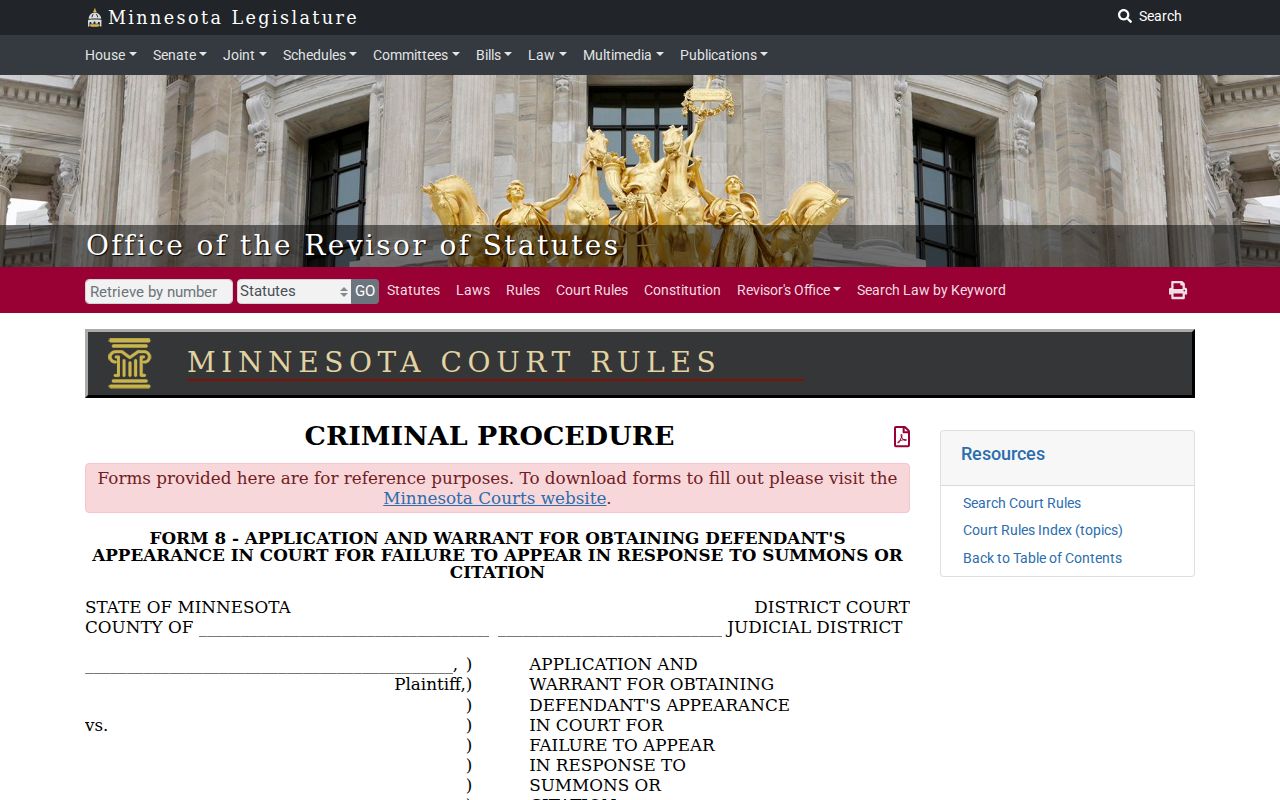
The form's structure makes one thing plain. A Pope County warrant answers a missed obligation; it does not add a charge.
Bench Warrants and Arrest Warrants Compared
People mix up bench warrants and arrest warrants all the time. In Pope County, the difference decides whether bail applies and whether an officer can take someone into custody.
| Point | Bench Warrant | Arrest Warrant |
|---|---|---|
| How it arises | A missed date, a condition violation, or noncompliance | A complaint supported by probable cause |
| Who issues it | The judge on the pending case | A judge after a probable-cause finding |
| Custody | Usually permitted, unless the order is sign-and-release | Permitted |
| Bail or conditions | Possible, and case specific | Possible, and case specific |
The release-condition framework in Rule 6 starts from release without bail, then permits the least restrictive conditions that protect appearance and safety in Pope County cases.
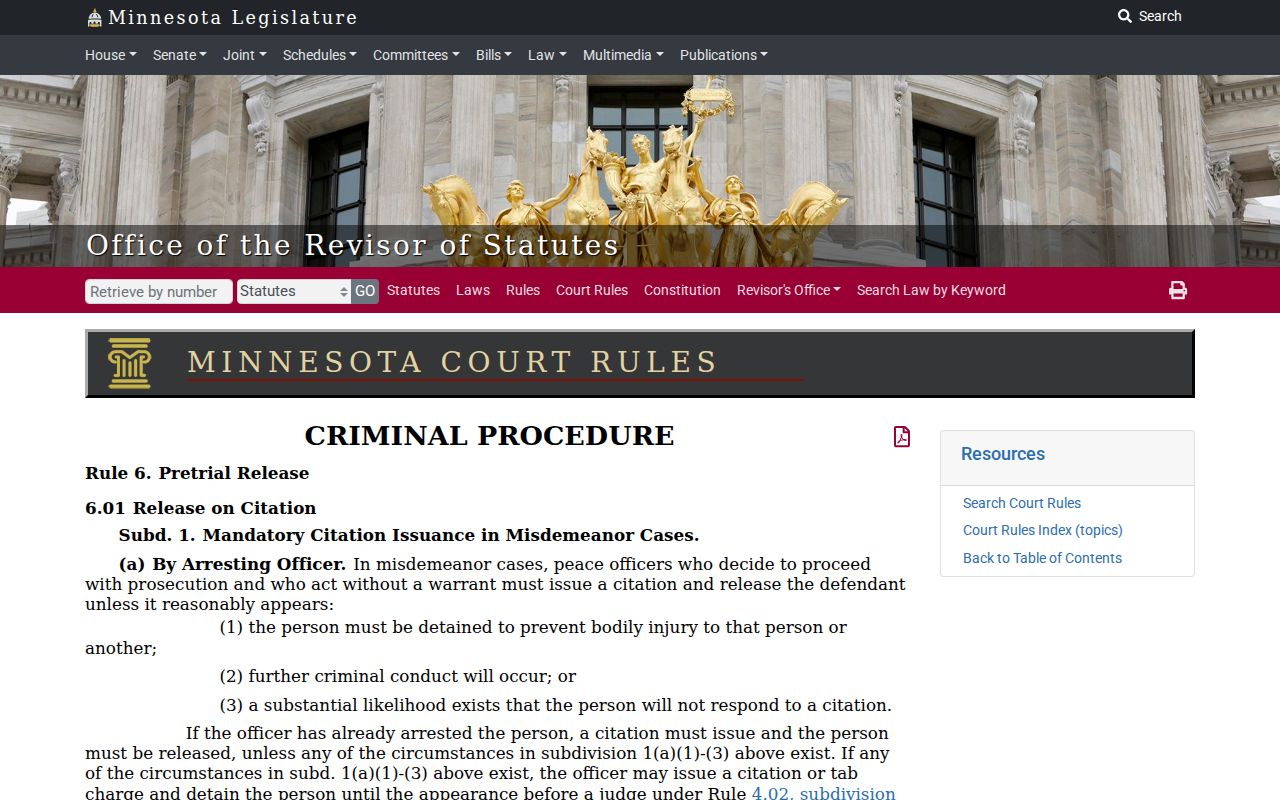
That framework explains why a bench warrant and a new charge lead to very different conversations in the same Pope County courtroom.
Missed Court Dates and Pope County Warrants
A missed date in Pope County can feel like a dead end. It is not. The way out starts with the same two facts every time: the case number and the reason for the absence.
- Get the case number off any notice, receipt, or letter.
- Read the Register of Actions in MCRO and note the event date and label.
- Call Court Administration and ask what the case now requires.
- Ask whether the court issued a summons, a sign-and-release warrant, or an arrest warrant.
- Ask an attorney about a motion to recall or quash, or about a voluntary appearance.
Note: Ask about each consequence separately, because a warrant, a late penalty, and a license report are three different actions in Pope County.
Resolving a Pope County Bench Warrant
Resolution is a court process, and it starts with the record. Ask Pope County Court Administration what the case requires now. Then ask whether the court will take a motion, a new appearance, or an arrangement on an unpaid obligation. No walk-in clearance window is published for Pope County.
Caution: A missed date can carry consequences beyond the warrant, including late penalties and a driver's license report under section 171.16. Ask about each one.
Keep written proof of everything you file or pay. A receipt shows a transaction, not that the court withdrew an order. The county overview of warrant steps walks through the same sequence for every warrant type handled in Glenwood.
Pope County Bench Warrant Status Words
Court staff in Pope County will use precise status words, and each one points to a different next step.
- Issued
- The judge signed an order. Nothing has necessarily happened on it yet.
- Served
- The authorized agency or person completed the process.
- Recalled
- The court withdrew its authority for the order.
- Quashed
- A second word courts use for withdrawing an order. Ask which one appears.
- Inactivated
- The status that follows the sign-and-release process.
Finding the Court That Issued the Warrant
One court issues bench warrants for cases filed in Pope County. District Court in the Eighth Judicial District handles criminal, traffic, civil, family, probate, juvenile, mental health, and ordinance matters filed here. That single channel makes a warrant search simpler than it is in states with municipal courts. If the case was filed in Pope County, the issuing court is Pope County District Court, and its records sit with Court Administration on the third floor of the courthouse in Glenwood. A case filed somewhere else belongs to that county's court, and this courthouse cannot read it. Check the county code in the case number against the county where the citation or charge originated. That one step tells you which clerk to call.
Restricted Records in Pope County Warrants
Some Pope County bench warrant matters never show up in a public warrant search, and the reason is classification rather than secrecy. Rule of Public Access 4 bars restricted, sealed, and administrative records from public access. That single rule explains a lot of blank results. Section 260B.171 sets separate limits for juvenile legal records, so a family or juvenile docket can display less than a criminal case would. Section 13.82(19) works differently. It can keep an arrest-warrant index confidential until custody, service, or appearance occurs. So a Pope County warrant lookup that returns nothing is an access result, not proof that no warrant exists. Anyone refused a record can ask for the classification citation and for any public portion that can be released on its own.